From a rural town in East Otago, TLC scholarship recipient and distance student Zenobia has built a thriving creative practice that spans painting, photography, community exhibitions, and arts advocacy. Studying through TLC’s Distance Delivery programme has allowed her to develop a sustainable arts practice while navigating the challenges of long Covid, all with the support of her Creativity Kaiako.
Kia ora Zenobia. Can you tell us a bit about your journey to studying art at TLC?
I developed an interest in art while at high school. While my natural strengths were in maths and science, I found myself drawn to artmaking. I enjoyed learning about artists and art movements, and painting was a safe space to express thoughts & emotions, and also to find a sense of calm. It became my dream to one day be a ‘real’ artist. I enrolled in a Visual Arts degree but dropped out within a few months.

It took several years to build the courage to return to painting after that, but I took small steps and held my first (and only) painting exhibition in 2016. In 2020, I bought my first camera and discovered a love for nature photography, which helped me find my way back to painting.
I was in my thirties before I had a regular practice again of regular sketchbook work, plein air sessions, and occasional exhibitions – but I knew I needed to push myself more to make art that really felt like ‘me’. It was at this time an ad for TLC scholarships popped up on my Facebook feed. I had recently met an artist who had studied at TLC and raved about the mentorship programme, so I knew this was my opportunity to get the mentorship my practice needed.

What inspired you to apply for a TLC scholarship?
I had heard from a previous student that TLC had an excellent distance programme which included a mentor. At the time, I was doing a lot of photography and had a regular sketchbook practice. I had also started to create art pop-ups in my local community. I felt that I’d gone as far as I could on my own and needed some mentorship to grow and be challenged, but I couldn’t afford it. It was around that time I saw a call for submissions on Facebook for TLC scholarships, and it felt like the perfect opportunity for me.
How did you feel when you found out you had been awarded the scholarship?
I was blown away! It was encouraging to learn that other people saw value in what I was doing. It also felt like a second chance, as I’d enrolled in an art degree after high school but didn’t complete it. It felt like a gift, which I was incredibly grateful for.
How has the scholarship influenced your creative journey and confidence?

How have your Creativity Kaiako (Mentors) supported you from afar?
I wasn’t sure what to expect when I first applied for distance learning, but I have been amazed by how much my CK (Creativity Kaiako) has been able to support me from afar. Through her feedback, encouragement, and guidance to reflect and challenge my assumptions, my CK has helped me as I continue to push my own creative limits and create work that is meaningful to me. She has also introduced me to a wide range of artists and styles that have informed my work and practice.
More than anything else, my confidence as an artist has grown exponentially and I credit my CK for this.
What is a typical creative day like for you at home? How do you keep yourself motivated while studying art independently?
I don’t think I have a ‘typical’ creative day! I have become an active member of the local arts community through teaching, informal mentoring, and pop-up exhibitions – I also exhibit regularly now. All of this, in addition to navigating the symptoms of long Covid, means that no two days are really the same.
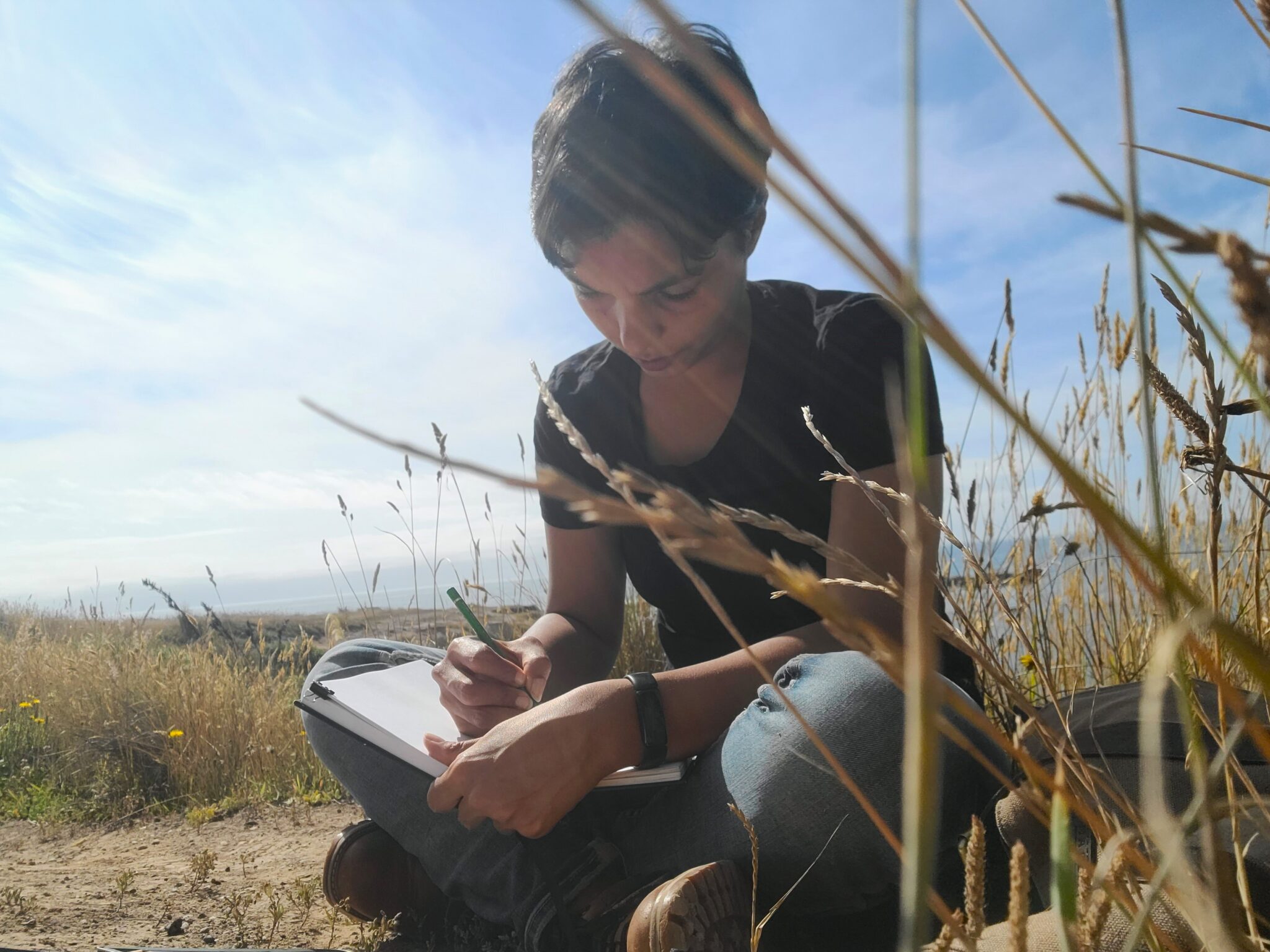
 I tend to have small pockets of creativity on a daily-ish basis, which may be photographing in my garden or on my walks, doodling in my sketchbook, or chipping away at a painting. I then have longer creative sessions two or three times a week. I may spend a few hours setting up and photographing a still life, painting plein air, or working on a painting.
Exhibiting and community contribution are also important to me. Living in a small rural town, we don’t have many opportunities for locals to display art, so I have organised several pop-up exhibitions for local creatives to exhibit & sell their work. This involves liaison with the venue owners, advertising, media outreach, and working with the exhibiting artists. All of this is part of my at-home creative practice, too.
I find my fortnightly check-ins with my Creativity Kaiako excellent motivation!
 I also book ahead for exhibitions and treat each one like a project. Booking ahead means I have a deadline to work towards, and I enjoy creating work specific to a theme and venue. At the moment I am working on a collection of paintings for a garden-themed exhibition at Colour + Light Gallery in Balclutha this October. This is a solo exhibition, so I am motivated by wanting to create a collection that I will be proud to show off when October comes around.

Has anything surprised you about learning art through distance study?
With art being such a hands-on practice, I wasn’t sure how I could really receive the support or feedback I wanted, but through the Workroom space, email communication, and regular video calls the course has far exceeded my expectations.
What do you feel are the benefits to studying through TLC’s Distance Delivery programme?
I chose to study via distance and part-time because I live in a small rural town, and have chronic fatigue as a result of long Covid. Having such a strong distance delivery option to study art has been life changing, because I don’t have the expense of travelling to the city to attend classes and I can work around my fatigue, which is often unpredictable – but I still get to participate in a programme that helps me build a strong creative practice.
 While I do sometimes look at the talks, classes, and exhibition opportunities that on-site students have with envy, I think the biggest benefit of studying via distance is being forced to develop a practice that is truly sustainable. While my CK is always happy to support me from afar, essentially I am on my own and I have to dig deep to find my inner motivation. It’s forced me to be more proactive in finding exhibition opportunities – or in some cases, getting creative and working with local businesses to make new exhibition opportunities.
Studying via distance means I have had the flexibility to work around my own hours and other commitments, but also means I have to manage my time and studio practice myself. This puts me in a good place moving forward, to continue a sustainable arts practice after I complete my diploma.
Does your location in Palmerston influence your creativity by way of your environment, the light, or the landscape?
My location and environment shapes the work I make, both in painting and photography.
A lot of my sketchbook work prior to starting at TLC was filled with plants and wildlife from my garden, and I bought my first camera after moving to Palmerston with the intention of capturing the changing seasons, expansive skies, and wildlife that I had rarely – or never – seen in real life. This was a big change from my art when living in Auckland, which was more abstract/symbolist and introspective.
For me, experiences like seeing a penguin in the wild, finding dragonflies my garden, learning about slugs, and watching fur seals basking on the shore are like fairytale magic. Through my art, I want to capture that and share that feeling; we live in a beautiful and fascinating world and I hope I can help people see that magic through my art. It is a joy to see all this life around me and I can’t help but share it.
Could you share a recent project or piece, experience or event, you’re really proud of?
My solo exhibition at the South Canterbury Museum is one I’m really proud of – not just for the work I put in, but for the courage it took to take the exhibition on. I received an email in mid-2025 from the museum director asking if I was interested, and a part of me felt like it was too big a project; that I wouldn’t be able to create enough work, or that I wouldn’t live up to their expectations. Somehow I mustered up the courage to say yes, and spent the next few months dreaming up ideas around the theme, curation, and flow in collaboration with the museum director. We decided to focus exclusively on wildlife, particularly native species. I created a paper model of the space to plan images, layout, and any museum artefacts to be included.
However, the date was brought forward by three months and it unfortunately overlapped with two smaller exhibitions on a similar theme. With less time and energy to dedicate solely to the museum exhibition, I revisited my planning. I simplified the layout and flow, and primarily used photographs I had already printed and framed. The museum had also generously offered to print some of my photographs on a large scale which added visual impact and balanced my smaller framed works.
I am proud that I was able to gather the courage to say yes, to collaborate with an established institution, and to curate a strong collection of work despite the installation date moving forward. As part of the exhibition, I gave a talk on International Day for Biodiversity as a fundraiser for the museum – so I am also proud to be able to use my art to promote conservation, and to give back to the museum.
What mediums do you enjoy working with most, and what draws you to them?
I am a multi-disciplinary artist, and work in painting, drawing, and photography. Each of these disciplines have a place in my creative practice and I tend to cycle through them.
Photography is my main focus. It is a newer discipline for me, and I love how experimental I can be. With a digital camera, I can try something out and check the back of my camera for immediate feedback, allowing for a fast pace of experimentation, feedback, and iteration. I love this aspect of photography and all the different techniques there are to explore – intentional camera movement, drawing with light, flash photography, coloured gels, and so much more. I also love that photography captures reality – but not necessarily what we can see with our human eyes. Photography helps me see the world in a new way, and I hope it does the same for people viewing my work.
In the past, I referred to painting as my ‘first love’. It’s a discipline that I worked hard to improve in high school, where I learned to paint with acrylics, but for several years I didn’t paint at all and lost some of these skills. In my mid-twenties I bought myself a children’s gouache paint set and it lit the fire for painting again. From there, I started learning to paint in watercolours and, more recently, oil. With digital photography as my main discipline, I love the hands-on (and screen-free) process of painting.
Are there certain themes or ideas that keep appearing in your work?
In my twenties, my creative practice was primarily fiction writing. It’s interesting to see that, while the subject matter is different, there are themes that have carried through. In particular, ‘a sense of wonder’ which I explored in story writing through the protagonist’s search for adventure; in early painting through abstract explorations of emotion and dreams, and in my photography through macro and astro photography.
How do you feel your art has evolved since starting with TLC?
I had a few personal goals that I wanted to achieve by the end of my diploma. The one I needed most help with was learning to dig below the surface to create work that was truly meaningful to me. Hand in hand with this was the goal to create a cohesive body of work, as I had a tendency to ‘dabble’ and not follow through on a concept.
While I believe in life-long learning and growth, my time at TLC has helped me achieve these goals. I am slowly peeling back the layers and making art that feels more authentic to me, while also bringing in influences from other artists.
 I realised that last year when I created a collection of cyanotype prints for exhibition, titled Pīwakawaka Blues. The day I installed this collection of work I felt incredibly vulnerable, and I realised it was a sign that I was digging deeper and sharing work that really felt like putting my heart on my sleeve. I’m grateful for the support of my CK, who has encouraged me to take risks in my creative practice.
Have you exhibited your work locally? What was that experience like for you?
I have had several exhibitions during my time at TLC, locally and further afield, and have also organised pop-up community exhibitions in my local town. In some ways, it feels more scary to display art in my own community – because everyone knows who I am so I feel more vulnerable to judgement and criticism.
Living in a small town sometimes makes me feel like my exhibition options are limited. It’s much harder to drop off and pick up art at exhibitions in the city when the time & cost is so significant, especially when sales aren’t guaranteed. But the lack of local exhibition opportunities has forced me to be proactive and I’ve worked with local businesses to create new opportunities for myself and other artists.
My first foray into a local display was a small display of art at my local café, which I change every three months. These are also for sale, and I usually make a sale in each rotation. The café staff are always excited to see what new art I bring each time, and have told me they get lots of comments on my display. I’ve also invited other local artists, and there are now three of us who share our work in the café. 
More recently, the high school art class have added their work, and the local museum also share historic photographs in the cafe. It took me a long time to approach the café owner and ask if I could put my art on their walls, but I love that it has encouraged other local artists and institutions to share their creative work as well. The café owner and staff have been wonderful and promote our work to their patrons – they’ve also let me sell my greeting cards and calendar which has been a great bonus for me.
On a larger scale, I am currently working with the Waikouaiti Coast Heritage Centre (the main museum in our East Otago region) to create a group exhibition celebrating the museum’s 5th anniversary. The main purpose is to use an art exhibition as a drawcard to promote the museum, and we will be holding talks and workshops throughout the exhibition to further engage our local community in the arts. There are 11 artists participating and we are each bringing different strengths to the table.
When I started creating pop-up exhibitions, I felt like I was asking the businesses to do me a favour by hosting us – but I’ve learned that they often feel it is the other way around! In addition to the museum and cafe, I’ve created pop-up exhibitions with a local gift shop, the public library, and the high school. It’s been a great learning experience for me, and a mindset shift around the value of the arts to our community.
How has studying art shaped your sense of self or your creative journey?
One of my biggest goals in applying to study at TLC was to develop my confidence as an artist. But the experimentation, reflection, and conversations with my CK to help me dig deeper into my core drivers for artmaking has also helped me become more confident and grounded in my sense of self.

What would you say to someone thinking about studying art from home?
I have already highly recommended TLC’s distance delivery course to friends, because the support that comes with the course – particularly from our Creativity Kaiako and the online resources is superb. There have been times I have needed more support, either facing a creative block or finding it hard to juggle with my health and other commitments, and my kaiako has helped me through these issues.
I have a space dedicated to my art practice, and I think this is important. From a practical perspective, you don’t have to pack and unpack every time you want to work on your art, but it also helps you (and your household) recognise that your art practice is a firm commitment.
What would you say to someone thinking about applying for a TLC scholarship?

Zenobia’s work is also for sale at our TLC Art Shop. Visit us at 182 Eastern Hutt Road, Taita to view her paintings and photography.
To find out more about our distance option and how you can study from home with support of a mentor, visit How to Study